
Avoiding Burnout in Social Media Roles at Language Schools
Avoiding Burnout in Social Media Roles at Language Schools
 Gina Rodriguez
 Social media burnout is becoming increasingly common among the people managing social media in small language school teams The main reason for this is that language schools tend to assign social media roles to staff who are already in other roles. So when marketing tasks are added on top of teaching, administration and customer care, with little time, training or support burning out is highly likely to happen.

About me: Hi, I’m Gina Rodriguez. I’m a qualified Digital Marketing Specialist and I work as a Social Media Strategist & Consultant for the language education sector . I have 25+ years experience in the English Language Teaching (ELT) industry. I have covered various roles from EFL teacher, teacher trainer to Sales & Marketing Consultant in educational publishing.
What I do: I help language schools and independent language professionals build an engaging social media presence through training, consultancy and tailored social media strategies.
👉Sign up to my newsletter for Social Media Post Ideas to keep you inspired and consistent.
For some teachers, freelancers and school owners, social media is a powerful marketing tool. It offers a way to reach new students, build trust and showcase their strengths. However, for many others, it feels like yet another job added to an already full workload. Social platforms reward constant activity, and maintaining a visible, engaging presence takes time, energy and planning.
This is where many language school teams get stuck. Without marketing know-how, it is easy to focus on entertaining content, follower growth and engagement for their own sake. That can work if your goal is influencer growth. It is far less effective if your goal is course enquiries and enrolments. As a result, schools post regularly, invest effort and still see little return (aka enquiries and enrolments) and staff suffers social media burnout.
The problem is rarely commitment, on the contrary, teams do their best. The problem is usually strategy, especially a clear social media marketing strategy that supports the generation of new contacts to increase enrolments.
In this article, I’ll explain when social media management becomes overwhelming in the language education sector and how to avoid burnout.
Interested in avoiding social media burnout? Read on!
What makes Social Media Marketing Overwhelming in the Language Education Sector
For many language school professionals social media is effectively a second job. School owners, Directors of Studies, academic managers, teachers and admin staff are often expected to keep their school visible on social media to generate enrolments even when marketing is not their core role.
In practice, that involves planning content, creating visuals, writing captions, recording video, taking photos, posting regularly, responding to messages, checking insights, tweaking and improving every time.
At the same time, the same people are managing teaching, timetabling, placement tests, parent communication and enrolment admin. Therefore, social media becomes an extra layer of work and source of stress and burnout rather than a helpful marketing tool.
These are, in my experience, some of the triggers of social media burnout (and waste of budget):
- 1.Lack of Social Media Marketing Training
- 2. Comparing bananas to apples
- 3. Following misleading marketing advice
- 4.Missing a social media strategy
1. Lack of Social Media Marketing Training
Carol Griffiths and Görsev Sönmez explore the hidden burdens of language teaching in Lessons from Good Language Teachers (Cambridge University Press, 2020), including the emotional labour and extended responsibilities that stretch far beyond teaching. Burnout, they explain, often arises when educators are pushed into roles for which they receive little training or institutional support.
In today’s attention economy. Language schools feel pressure to be present on social media, but many of the people managing that presence have not been trained in marketing. They do their best, often with good intentions and a lot of effort, yet the results are inconsistent.
So the problem isn’t lack of time. The problem is using a powerful tool without knowing how it really works. The problem is ignoring that the focus for a language school on social media is not likes.
2. Why comparing bananas to apples?
To make matters worse, “comparisonitis” creeps in. I see this all the time. School owners comparing their school’s social media results (likes and followers) with other schools which actually have a full marketing teams . In other cases they compare their pages with influencers’ pages.
Trying to keep up with bigger schools without the same dedicated budget, team or training leads to frustration, wasted effort, and often burnout. Fortunately, with a simple shift in how you approach social media, it can become a manageable, even meaningful tool to market your language services.
Then everyone blames social media . Social media isn’t the problem. The pressure to perform like influencers or bigger schools without support, training or clear purpose is the real problem . Stop comparing bananas to apples!
3. Following Misleading Marketing Advice
Another source of stress in the language education sector is the amount of misleading marketing advice circulating from non-marketers. Much of it sounds confident, but it is not grounded in strategy. Advice like “post every day” or “be on every platform” adds pressure and rarely improves enrolment outcomes.
Here’s a useful table that will help you stay away from misleading marketing advice and protect your mental health:
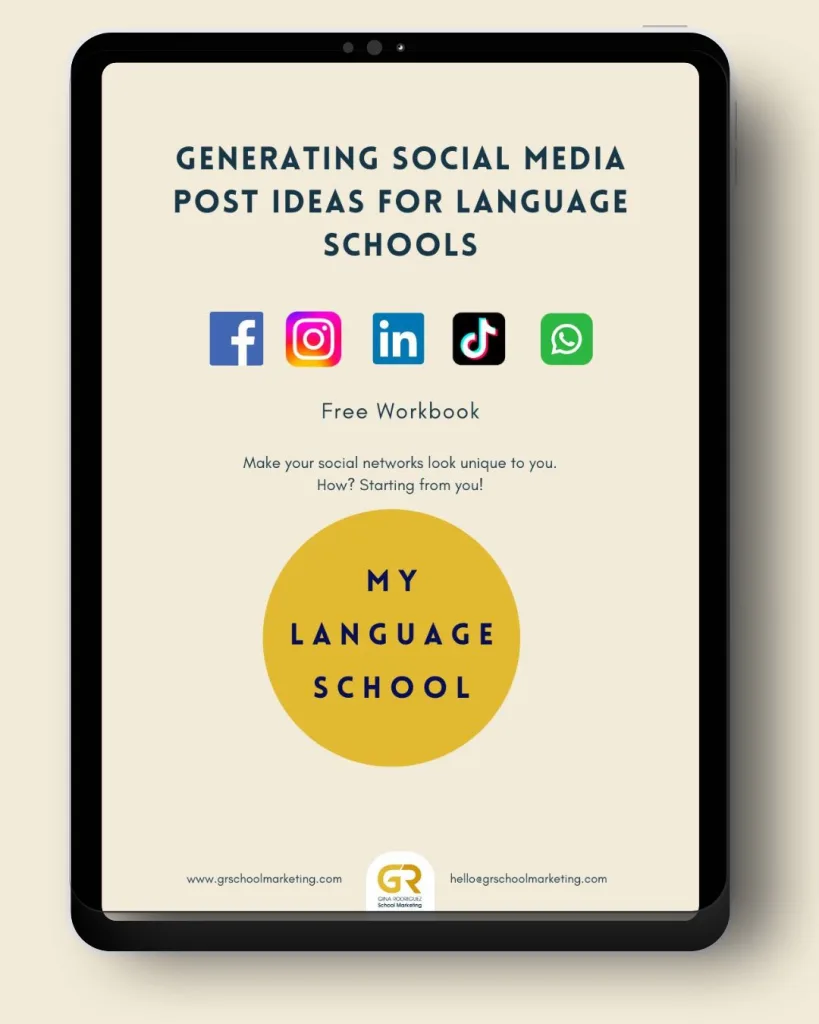
- Download the Social Media Ideas Workbook now to get:
- A mind map of ideas for social media posts.
- A worksheet with prompts for brainstorming your ideas
- Clear instructions for organising your ideas.
- Tips for creating posts for your school.
4. Missing a Social Media Strategy
If you feel exhausted and frustrated by social media, it does not necessarily mean you are doing too much. One of the reasons could be that you are working without a clear direction.
When there is no strategy, social media becomes reactive. For example, you post when you remember, you scramble for visuals, and you choose topics at the last minute. You also end up chasing whatever seems to get engagement and even copy trends that do not fit your audience or the language sector.
Then posts flop, you feel frustrated day in day out and this is where burnout grows.
The shift that makes social media sustainable is simple: treat social media as a business asset which is part of your language school overall marketing strategy.
How to Make Social Media Marketing Sustainable for your School Staff
A sustainable social media marketing strategy for language schools focuses on three priorities. First, reach the right people. Second, show what makes your language services valuable. Third, build trust over time. Without trust, enquiries and enrolments are much harder to win.
Once you view social media in this way, it becomes less of a performance and more of an asset. In other words, you stop chasing algorithms and start creating content that supports your school’s enrolment objectives.
1.Shift Your Perspective: You Are Not an Influencer
Here is the line I repeat most often to school teams: you are not an influencer. You are a school owner, an academic manager, a teacher or a staff member trying to reach learners, communicate value and convert interest into an enrolment.
Your goal is not to grow followers for the sake of it. Likes and reach can be useful signals. That said, they are not the end goal. They become vanity metrics when they are not connected to outcomes.
2.Start From the Bottom Up: The Content Planning Method That Reduces Overwhelm
Most overwhelmed school teams ask, “What should we post today?” This question creates pressure because it forces you to generate ideas from scratch, repeatedly, with no direction.A bottom-up approach flips the process. You start from your own goals.Then content becomes easier. Try this:
First, define your goal. For example, you may want to promote a juniors course, build trust among cold leads or increase bookings for a placement test.
Next, define your audience. Are you speaking to parents, adult learners, teenagers, companies, agents, or a mix that needs separate messaging?
Then clarify what makes your language course better than your competitors’ courses. This is your value proposition. It may be personalised feedback, flexible timetables, excellent student support. Note it down.
Finally, list the resources you already have. This includes testimonials, classroom photos,FAQs and behind-the-scenes processes just to mention a few.
Once you have these foundations, create three or four content pillars. These pillars become your anchor. As a result, you stop guessing and start planning.
This is what makes a sustainable social media strategy possible for busy language schools: fewer decisions, less last-minute work, and content that supports marketing goals avoiding social media burnout.
3.Show, Don’t Tell: Gather Reusable Visual Content That Supports Enrolments

In social media marketing for language schools, one principle matters more than almost any other: show, don’t tell. Your audience can read claims anywhere. What they need is proof and clarity. They need to see what learning looks like, what support feels like, what your teachers bring, and what outcomes students achieve.
This is why visual content is so important, particularly on highly visual platforms such as Instagram and TikTok.
The challenge is that many schools don’t keep a reusable visual library with strategic photos and videos organized in a single place. Consequently, they waste time looking for visuals or post random photos which don’t showcase the school’s strengths and vibes.
Here is a simple exercise that helps you gather strategic visual content to build a reusable visual library
✔️Start by writing your value proposition in plain language. For example: “We help students move forward and achieve real language objectives. Our lessons are dynamic, personalised and practical. Our teachers receive ongoing training and use effective methodologies. We also develop communication skills such as public speaking, creativity and digital literacy.”
✔️Now open your social media page and scan your most recent posts. Ask yourself whether at least 80 percent of your photos and videos show evidence of that value proposition. If they do, you are building clarity and trust. If they do not, your audience is left to guess what makes you different. In that situation, they often default to comparing price.

Learn how to build a visual library with Generating PLUS
What Different Language School Roles Can Do to Prevent Social Media Burnout for Staff
If you are a freelancer or a small school owner:
The biggest risk is trying to do everything on your own. The solution is a simpler plan. Reduce the number of platforms, reduce the number of content formats, repurpose and have templates ready.
If you are a teacher or admin staff managing a school’s social media
The most important point is support. What expectations has your school set? What training, time and resources have been provided? If social media is part of your role, it should come with clear objectives, content pillars, access to visuals, and a realistic posting schedule.
If you are an academic manager, Director of Studies or school owner supervising social media staff:
The question is culture. Do you consider content creation a last-minute task, or as a strategic process? Do you give your team clarity, planning time and training? Do you support them with resources, permissions and content capture routines? When the role is treated as strategic rather than reactive, burnout drops.
Final Thoughts: What I wish Language School Leaders Understood
Social media is a powerful ally for language professionals and institutions, but only if it serves your goals, not the other way around. Burnout often comes from trying to do too much, imitating strategies that do not fit your context, and investing energy in posts that don’t bring direct messages, placement tests sign ups or enrolments.
You do not need to be on every social media platform. You do not need to post every day. And you do not need to act like an influencer.
What you do need is a clear, realistic social media marketing strategy that connects content to objectives, highlights your strengths, and fits the time and resources you actually have.
When you approach social media from the bottom up, starting with goals and building content around them, visibility becomes manageable and even rewarding. As a result, you build trust, communicate value, and create a presence that supports enquiries and enrolments.
A strong social media strategy for language schools isn’t about just posting, it’s about clarity, consistency, and conversion. If you’re ready to stop posting and praying on social media, I’m here to help. Drop me a line at hello@grschoolmarketing.com or book a free discovery call — let’s find out if I can support your goals.
From social media strategy to content creation and training, GR School Marketing supports language education brands in building a strong online presence.
