Social Media Strategy for Language Schools: Myths to Avoid
Social Media Strategy for Language Schools: Myths to Avoid
 Letizia Muffo
 As more ELT educators step into the world of online teaching, coaching, and freelancing, the rise of teacherpreneurship is transforming the ELT space. And with that rise comes the pressure to market language services, build a presence on social media, and attract the right students ideally through a strong social media strategy for language schools.
Here’s the problem: too many language schools and teacherpreneurs are following social media marketing advice from other people in ELT who aren’t actually marketers.

About me: Hi, I’m Gina Rodriguez. I’m a qualified Digital Marketing Specialist and I work as a Social Media Strategist & Consultant for the language education sector . I have 25+ years experience in the English Language Teaching (ELT) industry. I have covered various roles from EFL teacher, teacher trainer to Sales & Marketing Consultant in educational publishing.
What I do: I help language schools and independent language professionals build an engaging social media presence through training, consultancy and tailored social media strategies.
Sign up to my newsletter for Social Media Post Ideas to keep you inspired and consistent.
Yes, some ELTers have built a fantastic online presence, however that doesn’t make them qualified to teach marketing or to offer ELT marketing services.
Ironically, it’s a bit like native-speakerism i.e hiring someone to teach English just because they were born in an English-speaking country but not because they have got the teaching qualifications to do so.
Consider this: if you’re a language teacher, school owner, or ELT freelancer trying to market your courses, following the advice from non-marketers will be a waste of your time, burn out your energy, and get you poor results.
And by results I mean enquiries, enrolments, contracts NOT likes, comments and shares! A language school’s social media page should be another business asset that will help the school achieve its business objectives. Social media should be helping the school or the freelancer promote their courses so the ultimate goal is social selling not the mere like.
Sadly, I can see a growing trend of ELTers dispensing marketing advice which very often has lots of misleading advice in the mix that you’d better avoid!
In this article I’ll look at misleading ELT marketing advice I have heard lately in ELT events so that you can recognise it and ignore it. If you want to protect your language business, read on!
Table of Contents
- The Consequences of Following Advice from Non-Marketers
- Social Media Strategy for Language Schools: Myths to Avoid
- Why a Social Media Strategy for Language Schools Requires More Than Tips
- ELT Marketing Specialist vs a Generalist
- Choosing the Right Support for Your Language School’s Social Media Strategy
- Final Thoughts: Why Build a Social Media Strategy for Your Language School
The Consequences of Following Advice from Non-Marketers
There’s a difference between someone who has done well with their own content and someone who is a qualified marketer and understands the language education sector.
Many teacherpreneurs and coaches in ELT are now selling courses or giving talks about ELT marketing and personal branding based purely on their own experience. That’s not necessarily harmful until that advice gets passed off as universally applicable, without context or strategy.
When that happens, inevitably language schools and teachers will:
- Waste time on platforms their audience doesn’t use
- Burn out trying to post every day
- Imitate others’ posts that don’t fit their own offer leading to zero results.
- Repost random content, hoping for likes (and likes don’t pay your bills)
- Confuse visibility with results when looking for enrolments
And here comes another consequence of this. The damage isn’t just for language schools and teacherpreneurs. It also undermines the work of ELT marketers who do have the training, tools, and track record to help.
Non-marketers’ advice very often creates unrealistic expectations and false ideas about social media marketing that are hard to debunk making it challenging to work with the client.
Social Media Strategy for Language Schools: Myths to Avoid
Let me share some of the most misleading pieces of advice I have heard recently on social media and in ELT conferences from non-marketers and explain why they won’t work and what you should do instead .
NB. These myths are exactly what can hold back a successful social media strategy for language schools . Knowing what to avoid is just as important as knowing what to do.
❌Myths | ⚠️Why it’s harmful | ✔️What to do Instead |
|---|---|---|
| “Post everyday” | Leads to burnout, inconsistent quality, no clear goal | Post consistently with purpose based on your audience and schedule |
| “Be on all social media platforms” | Spreads you thin, no clarity, dilutes your brand | Be where your audience is and where you can show up reliably |
| “Just repost content you like” | If you only repost content you will build others’ brands, not yours | Repost occasionally with your own opinion but focus on your own original content that builds authority |
| “See what others post and follow the trend! | Creates generic content, no alignment with your offer | Use your objectives to guide content |
| “Use stories, tips, quotes” | Sounds easy, but lacks strategy or funnel connection | Share content tied to your message, services and objectives |
| “Share grammar tips” | Teaching for free isn’t marketing | Show more of yourself, your personality, your story and values |
Why a Social Media Strategy for Language Schools Requires More Than Tips
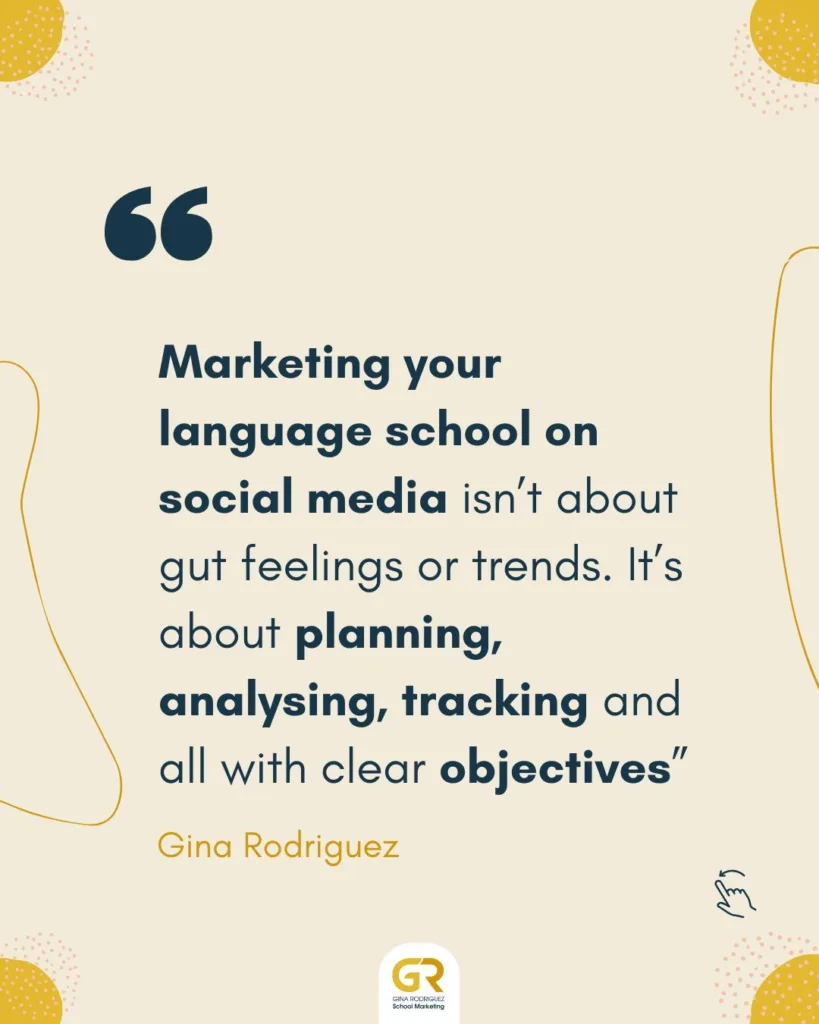
Marketing your language services is more than being active online. You need:
- A clear understanding of your target audience
- Defined goals (e.g., build trust, generate leads, increase enrolments)
- A content plan that aligns your posts to your overall marketing & sales activities
- Key performance indicators to be able to guide you in tracking results
If you don’t work this way, then of course you will be disappointed by poor results. If you are thinking, “ I don’t have time for that”, it’s understandable because marketing a language school can be a full-time job in itself.
The good news is that there are specialists marketers out there who can support you and guide you in creating a social media strategy for your language school.
Personally, I also believe that ELT professionals should educate themselves about social media marketing to be able to discern between good and bad advice or to supervise who does the social media for them.
If you don’t work this way, then of course you will be disappointed by poor results. If you are thinking, “ I don’t have time for that”, it’s understandable because marketing a language school can be a full-time job in itself.
The good news is that there are specialists marketers out there who can support you and guide you in creating a social media strategy for your language school.
Personally, I also believe that ELT professionals should educate themselves about social media marketing to be able to discern between good and bad advice or to supervise who does the social media for them.
ELT Marketing Specialist vs a Generalist
Personally, I believe ELT professionals should educate themselves about social media marketing, not to become marketers, but to be able to discern between good and bad advice, or to confidently supervise whoever is managing their school’s content and strategy.
In my blog post What is ELT Marketing?, I explain why marketing a language course is not the same as marketing wine, shoes, or pasta. Why? Because language education is not an impulse buy. It’s an investment of time, money, and long-term commitment.
People don’t sign up for a course because they want the language . They want the outcome: a visa, a degree abroad, a job promotion, or better prospects for their children. The motivations are deeper, the buying cycle longer, and the decision-making process more complex especially when the final user (e.g., a child) isn’t the person making the purchasing decision.
That’s why working with a specialist in ELT marketing matters.
An ELT marketer isn’t just someone who knows how to write captions or schedule posts. They understand the dynamics of the sector AND know how to deal with:
• Privacy concerns for learners
• Local markets and school-year timing
• Selling to parents and students
• Brand voice tied to pedagogy
• Marketing cycles aligned with enrolments
If one is unaware of these “nuances”, the advice they give, even if with good intention, can do more harm than good. Why? Because it’s based on personal experience, not on sector-specific insight or hands-on experience.
In fact, what most teacherpreneurs and language schools need isn’t just tips. They need a real social media marketing strategy that’s grounded in the ELT context and aligned with their goals, resources, and audience.
Choosing the Right Support for Your Language School’s Social Media Strategy
So how can you protect your school or teaching business from poor advice and start making real progress with your marketing?
Here’s what I recommend:
✔️ Read specialist blogs
Read blogs and use resources focused on marketing for language education NOT general business or lifestyle coaching. (Start with mine, if you like!)
✔️ Work with a marketing specialist in the language education sector
i.e. Work with someone with both marketing qualifications and real experience in ELT.
✔️ Ask for case studies or real examples
Ask of how they’ve helped other language schools or teacherpreneurs get results.
✔️Look for strategic insights not just tips
When attending webinars or talks about language school marketing ,stay away from a list of random content ideas or engagement hacks.
In short, trust people who are “fluent in both languages”: the language of marketing and the language of education.
Final Thoughts: Why Build a Social Media Strategy for Your Language School
If you’re a teacherpreneur or language school trying to build a social media presence, remember:
The right social media strategy saves time, boosts results, and feels aligned with your goals and resources (aka time and budget).
Gina Rodriguez
Bad advice doesn’t consider your objectives, capacity, or sustainability. It doesn’t just waste energy it takes you away from what truly matters: your students, your teaching, and your school.
As a teacher, DOS or school owner, your main responsibility is teaching. For this reason, marketing shouldn’t be a burden. It’s important to have a strategy that allows you to have your own way of marketing your teaching business online. And if you can’t create one, then consider asking for help!
The worst thing you can do is waste time trying tips from non-marketers or generalists that don’t bring results. By doing so, you will be running the risk of hurting your school or experience burnout.
That’s time and energy you could be spending on what only you can do: teaching, leading, and supporting your students.
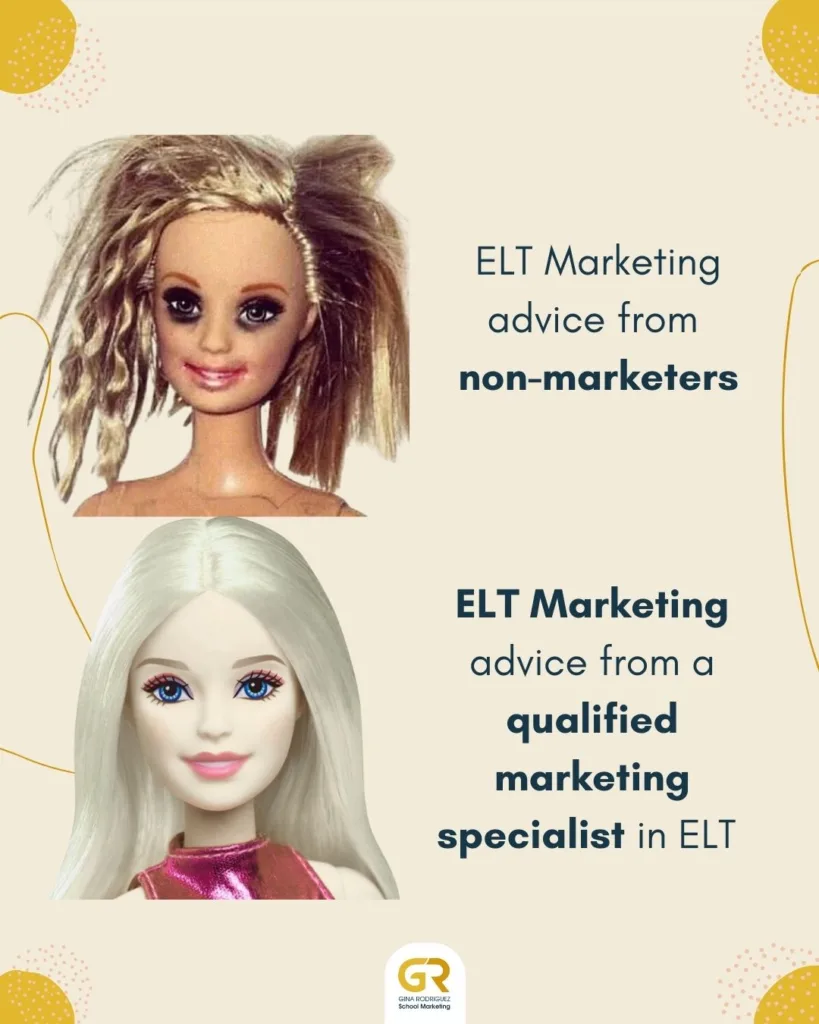
So instead of chasing hacks, choose a roadmap.
Hacks and tips are everywhere in the ELT world. But make sure you’re taking advice from those who are qualified and experienced.
Hacks might work for the moment, but what truly makes a difference is a tailored strategy, a roadmap designed around your goals, your time, and your resources.
A strong social media strategy for language schools isn’t about just posting, it’s about clarity, consistency, and conversion. If you’re ready to stop posting and praying on social media, I’m here to help. Drop me a line at hello@grschoolmarketing.com or book a free discovery call — let’s find out if I can support your goals.